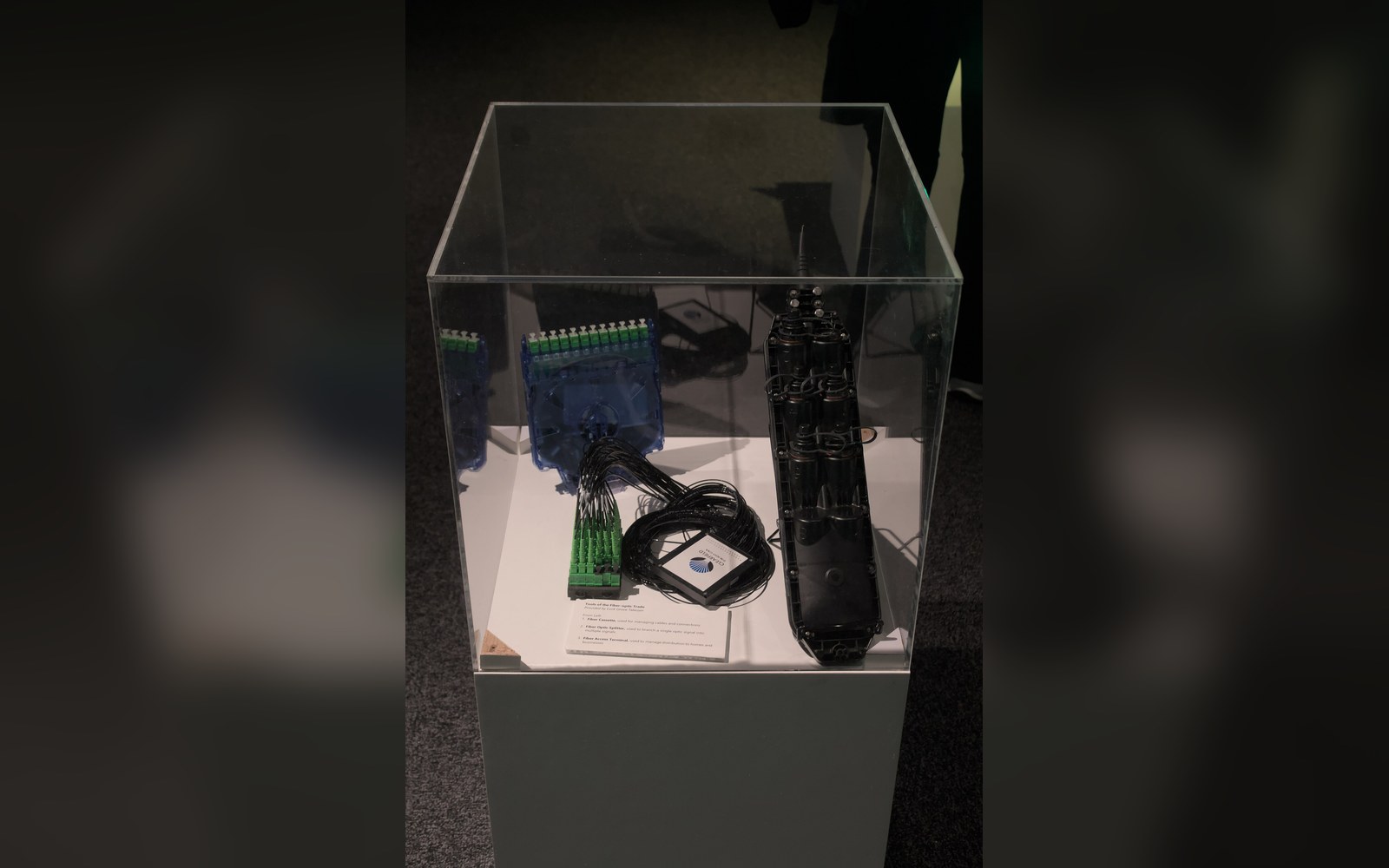
The tree in the ground
GPON — Gigabit Passive Optical Network — is the dominant fibre-to-the-home standard in the United States, and the word "passive" is load-bearing. Between the provider's central office and the customer's optical network terminal on the wall, there are no powered components: no amplifiers, no active switches. The only thing that sits in the distribution network is a small prism-like coupler, the passive optical splitter, usually buried in a roadside enclosure or mounted in a pole-mounted closure.
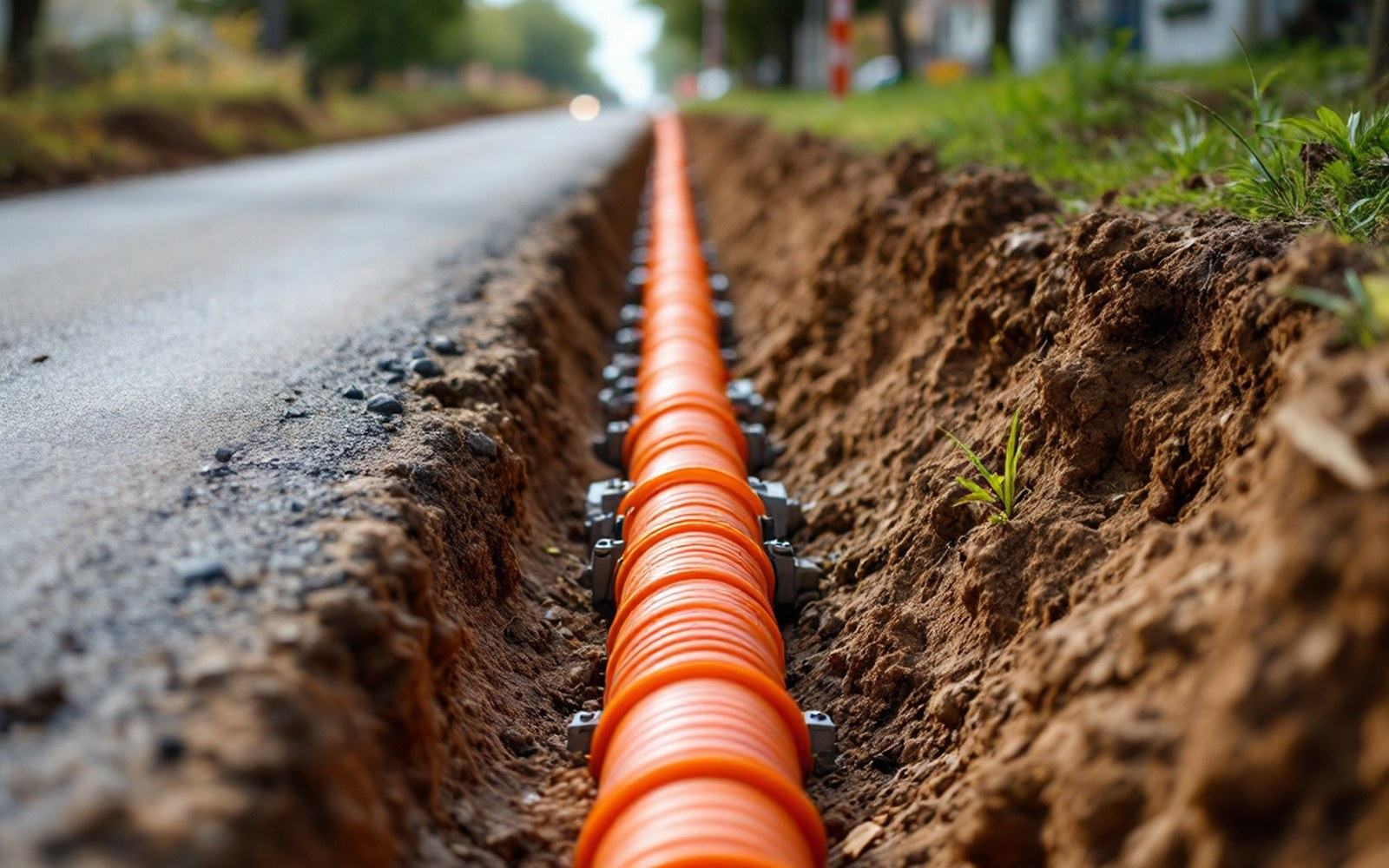
A single strand of glass — the feeder fibre — runs from the headend to that splitter. The splitter divides the signal optically, without electronics, typically in a 1:32 ratio, sometimes 1:64. From that point, thirty-two (or sixty-four) individual drop fibres run to individual premises. The whole assembly forms a tree: one trunk, one branching point, many leaves. Every home on that branch is reading off the same feeder fibre.
Key numbers
Downstream, the headend broadcasts a signal at 2.488 Gbps across the entire tree simultaneously; each optical network terminal reads only the packets addressed to it. Upstream is time-division multiplexed — the headend assigns each terminal a specific window in which to transmit, so nobody steps on anyone else. The aggregate upstream capacity on GPON as standardized by the ITU-T in G.984 is 1.244 Gbps, shared across the whole split.
What the split ratio costs you
The math is straightforward. At 1:32, thirty-two subscribers share 2.488 Gbps downstream and 1.244 Gbps upstream. Divide evenly and each subscriber's theoretical ceiling is roughly 77 Mbps down and 38 Mbps up — but GPON was designed with the expectation that not everyone transmits at once, and in practice oversubscription is managed by traffic shaping and the statistical reality of usage patterns. Providers who advertise symmetrical gigabit over GPON are counting on that statistical multiplexing: the capacity exists at the feeder level, and most of the time the contention stays invisible.

The split ratio is also an engineering trade-off in the literal cost of the plant. Each drop fibre must reach from the splitter to the premises. A 1:32 split in a dense suburb, where homes are close to the splitter, is economical. A 1:32 split in a rural township, where drops might run a quarter-mile to reach a single house, is expensive per passing. This is one reason the cost per home passed varies by an order of magnitude between dense and rural deployments: the passive architecture that makes urban GPON cheap makes rural GPON costly.
Chronology
- G.984 (GPON standard)ITU-T, original publication 2003
- G.9807.1 (XGS-PON)ITU-T, 2016
- FCC broadband fabric replacing Form 477 census-block mappingphased in from 2022
The successor standard, XGS-PON (ITU-T G.9807.1, published 2016), runs at 10 Gbps symmetrical on the same fibre infrastructure with compatible splitters, which is why operators upgrading from GPON to XGS-PON can often reuse the outside plant and replace only the line cards at the headend and the terminals at the premises.
Where Loudoun County sits
Loudoun County, Virginia illustrates the geometry vividly. One of the fastest-growing counties in the country by population through the 2010s, it contains both dense new-build subdivisions — where GPON trees drop short fibres to MDU risers — and working farms where any PON deployment would require long, expensive individual runs. The FCC's broadband fabric, which maps individual serviceable locations rather than census blocks, makes the contrast legible at the parcel level in a way that the old Form 477 census-block method never could. A splitter closet that serves a 500-unit townhouse development and a splitter closet that serves eight rural properties on a gravel road both contain the same passive coupler; the economics of the two trees are nothing alike.