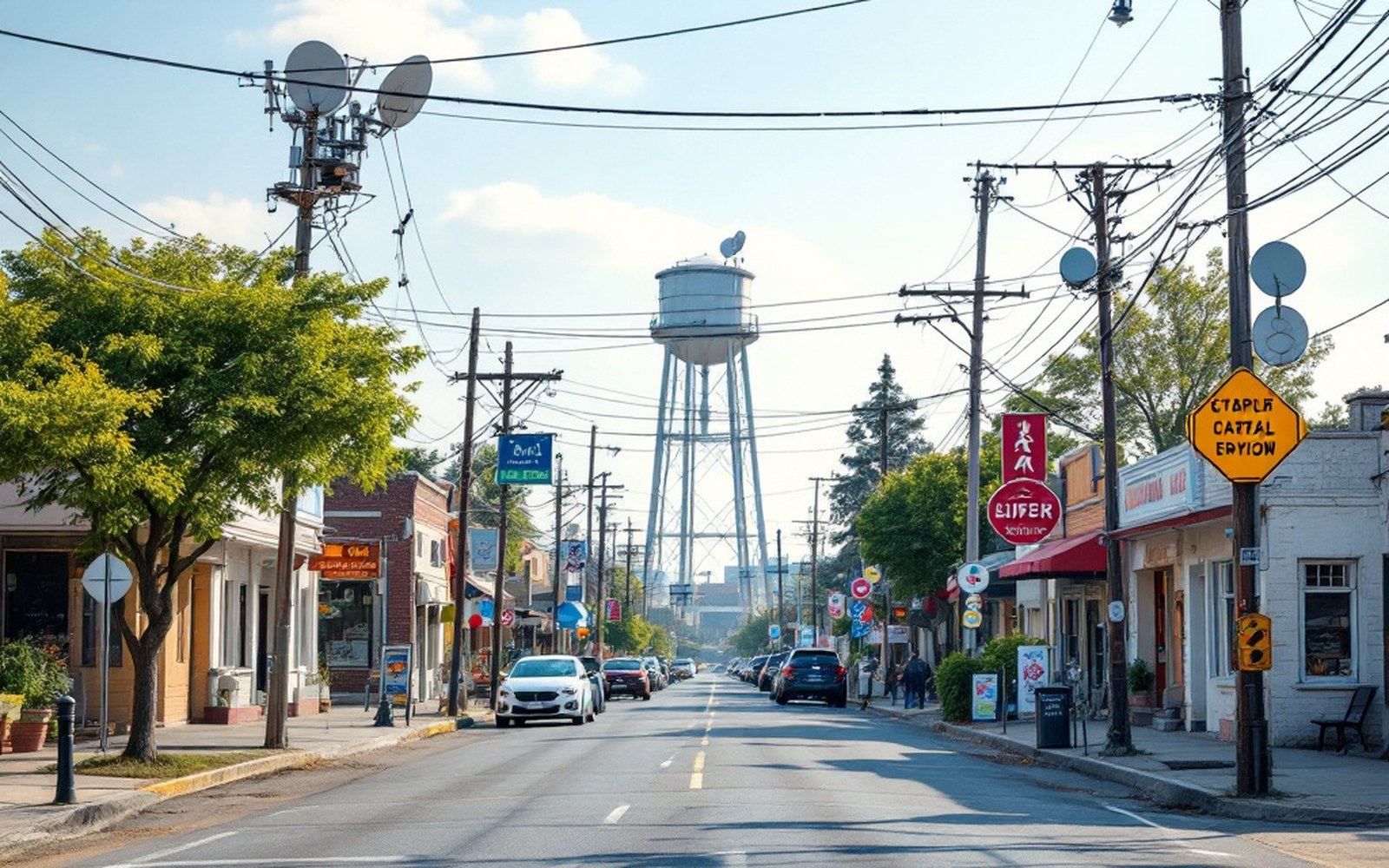
When the commercial case never arrived
The threshold at which a private operator will extend or upgrade a network is not a mystery: it is a density calculation, worked against projected take-rate and capital cost. When that arithmetic comes up short, the territory stays dark. In hundreds of American towns that moment arrived and passed years ago, and the response — in a small but documented subset — was to build the network themselves. Three cases show what that actually produced: one that worked cleanly, one that required patience, and one that became a cautionary dataset.

Chattanooga, Tennessee, is the most cited and the most thoroughly documented. The city's electric utility, EPB, was already upgrading its distribution grid with a fiber-optic control network when, in 2007, it decided to extend that same fiber to every premise in its service territory. The logic was pragmatic: once you are pulling glass for smart-grid sensors, the marginal cost of adding a passive splitter and a subscriber port is manageable. EPB launched its gigabit residential service in 2010, making Chattanooga one of the first US cities to offer symmetrical gigabit broadband to all residents, not just a cherry-picked corridor. The network's GPON architecture — Gigabit Passive Optical Network, a single fiber from the exchange point divided passively among dozens of homes — meant the distribution plant carried almost no active electronics outside the headend, keeping operating costs low and reliability high. EPB's territory covers roughly 170,000 premises. By the time the American Recovery and Reinvestment Act broadband grants closed, EPB had already passed every address. The utility's own reporting has consistently shown take rates above 40 percent, a figure commercial operators achieve in markets where they face no competition.
Chronology
- 2007EPB (Chattanooga) decides to extend smart-grid fiber to subscriber premises
- 2008Wilson, NC launches Greenlight fiber network
- 2010EPB begins gigabit residential service; Chattanooga becomes among first US cities with city-wide symmetrical gigabit
- 2011North Carolina passes HB 129 (Level Playing Field Act), restricting Greenlight expansion
- 2015FCC attempts preemption of state municipal broadband restrictions; 2016 Sixth Circuit reverses
- Post-2020FCC broadband fabric replaces census-block Form 477 reporting; NTIA requires fabric for BEAD grantees
The political context that made Chattanooga possible is specific: Tennessee's EPB is a municipal utility with existing pole and conduit rights, an existing construction workforce, and a customer relationship predating the build by decades. Those conditions do not transfer automatically. In states where incumbent carriers successfully lobbied for restrictions on municipal broadband — nineteen states carry some form of such restriction as of the most recent count — the Chattanooga model is legally unreachable without a change in statute.
A county that built what the incumbents mapped as served
Loudoun County, Virginia, spent years watching its rural western precincts appear as served on FCC Form 477 maps while residents a short drive from the Dulles corridor could not sustain a video call. The Form 477 mechanism — counting an entire census block as covered if a single location in it could theoretically be connected — produced maps that made commercial deployment look complete in areas where no technician had ever pulled cable to a farmstead. When the FCC's broadband fabric replaced the block-level system with individual-location records, the gap between the maps and reality in Loudoun's rural west became documentable in a way that the old data structure had obscured.
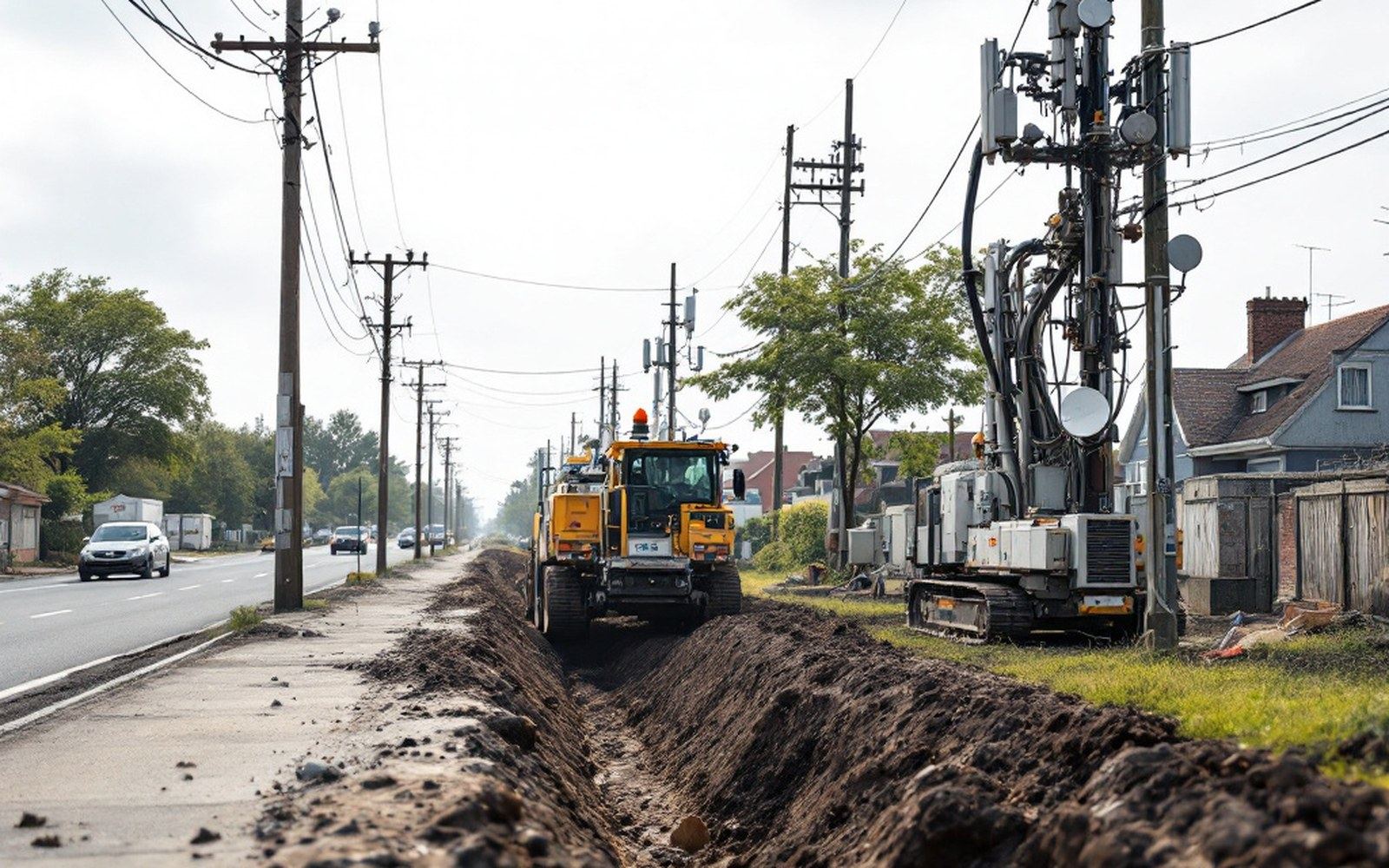
Loudoun's response was a county-financed extension program that used a combination of fiber-to-the-premise builds for denser clusters and fixed wireless as an interim plant for scattered addresses too expensive to serve by glass alone. The county issued bonds, contracted construction, and operated the middle-mile infrastructure itself while allowing private last-mile providers to interconnect at county-owned aggregation points. This hybrid model — public middle mile, private last mile — deliberately avoided the regulatory complexity of becoming a retail provider. It also meant the county absorbed the highest-cost segment of the build, the trunk infrastructure, and left the commercially viable retail relationship to operators who already had billing systems and support staff. The co-op model used in rural electric territories works on a similar logic: existing infrastructure rights cut the cost per home passed enough to change the arithmetic entirely.
| EPB / Chattanooga | Municipal electric utility, full GPON build, ~170,000 premises, gigabit from launch, unrestricted by state law |
| Loudoun County, VA | County-financed middle mile, private last-mile operators, hybrid fiber + fixed wireless for scattered addresses |
| Greenlight / Wilson, NC | Municipal utility, GPON plant, ~50,000-person city, grandfathered but expansion blocked by HB 129 |
What Loudoun's program illustrates, beyond the connectivity itself, is the evidentiary problem that preceded it. Without location-level data, a county cannot produce a fundable challenge. The challenge process, where it works at all, depends on granular records that carriers spent years arguing were proprietary. The shift to fabric-based mapping — which the NTIA required grantees to use for the BEAD program — changed what a rural county could prove and therefore what it could fund.
Wilson, North Carolina: a utility that outran its statute
The third case is Wilson, North Carolina, where the city's electric utility, Greenlight, launched a fiber network in 2008 to serve a city of roughly 50,000 people who had two broadband options: Time Warner Cable and a DSL product from AT&T that was functionally obsolete on the day of purchase. Greenlight built to gigabit capacity from the start, using a GPON plant comparable to EPB's, and reported strong take rates through its first several years of operation.

The instructive part of Wilson's story is what happened next. In 2011, the North Carolina state legislature passed HB 129, the Level Playing Field Act, which imposed operating restrictions on municipal broadband providers that had no equivalent for private carriers — the name of the act encoding the argument of its commercial-operator sponsors. Wilson's Greenlight was grandfathered, but expansion to neighboring counties was effectively blocked. The FCC attempted to preempt the restriction in 2015; the Sixth Circuit reversed that preemption in 2016, finding that the agency lacked authority to override a state's control over its own municipal entities. The network continued serving Wilson proper and remains operational, but the moment it might have expanded to serve rural Pitt and Edgecombe counties — areas that today still rank poorly on any access measure — was closed legislatively.
Wilson is not a failure in network terms: the plant works, the take rate is real, and the city's residents have a service option they would not otherwise have. It is, however, a demonstration that a technically successful build can be contained by statute in a way that limits its effect to the city limits where it started.
What these three document
Chattanooga, Loudoun, and Wilson share an origin: a density-and-return calculation that private operators ran and declined. They differ in scale, ownership model, state law, and longevity, and those differences produce meaningfully different outcomes. What they jointly establish is that the municipal network is not a genre of idealism — it is a capital project with a cost per home passed, a take-rate target, an operating model, and a legal operating environment. The numbers and the statute govern the outcome more than the politics of the decision to build.