What the ground-based version does
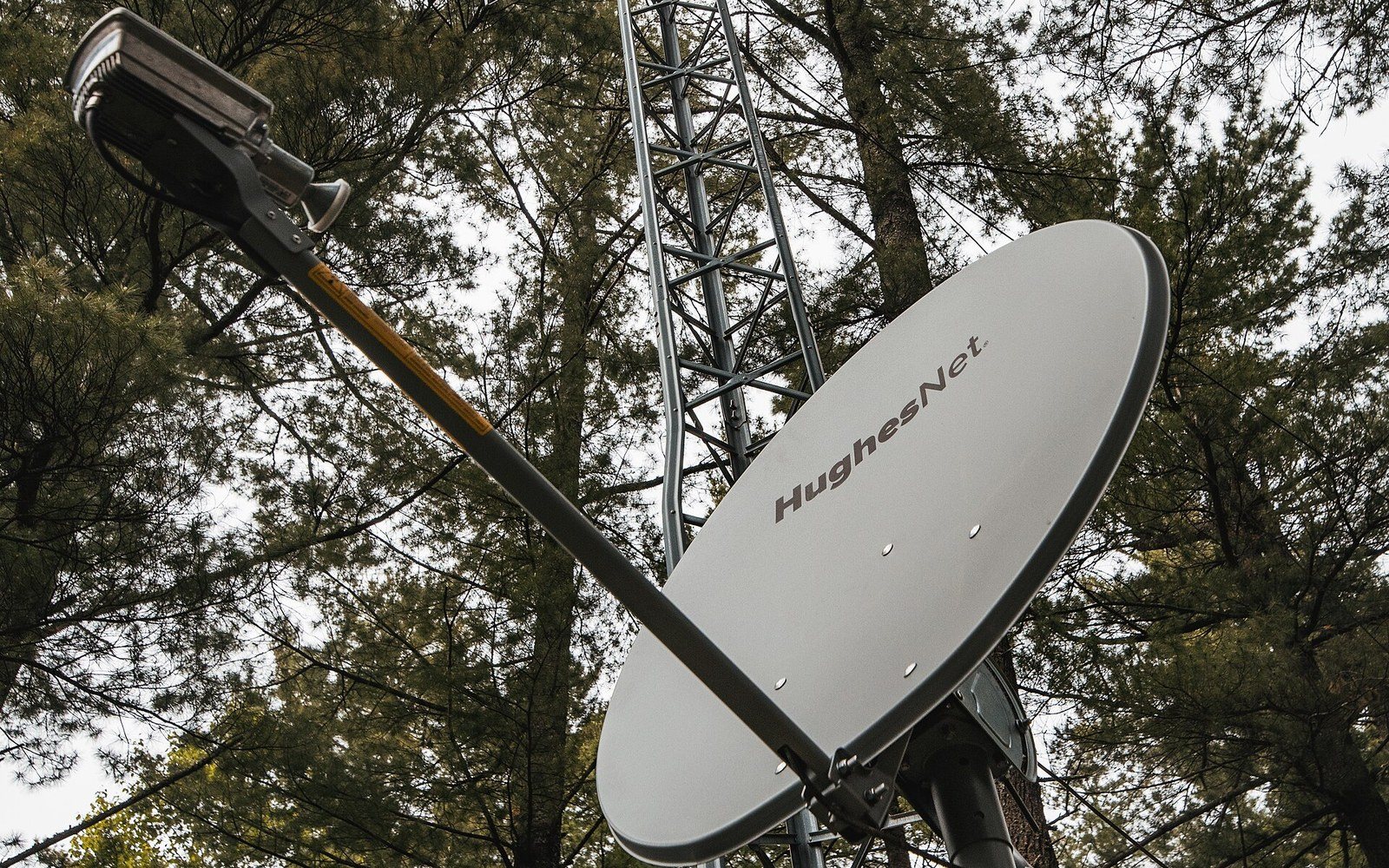
Fixed wireless access — the terrestrial kind — works by pointing a small antenna at a cell tower rather than running a cable to a structure. The signal travels through licensed or unlicensed spectrum, gets collected at the customer premise unit, and hands off to the router inside. The plant footprint is light: one tower covers a radius that would take a trenching crew months to wire, which is why carriers deploy it at the edge of their wired networks rather than at their core.
The limit is physics. Spectrum is shared among every subscriber sector on a given tower, so throughput per customer shrinks as a cell fills. Trees, terrain, and building stock all attenuate the signal before it arrives. The FCC's broadband data collection has tracked fixed wireless availability since the Form 477 era, but coverage claims have always been generous: a tower's maximum range stated on a map is not the throughput a subscriber on the far edge of that range actually receives. In Loudoun County, Virginia — where data center density makes middle-mile capacity abundant — fixed wireless is a convenience product. In mountainous rural Virginia, it is often the only option, and its signal geometry is punishing.
What the orbit adds
Low-earth-orbit (LEO) satellite sits between roughly 340 and 1,200 kilometres above the surface. That is orders of magnitude closer than the geostationary arc at 35,786 km, which is why the round-trip latency collapses — from the 600-millisecond or longer delays of legacy geostationary broadband down to the 20–40-millisecond range that SpaceX's Starlink reported in FCC filings and testing. At those figures, a LEO connection can run a video call or a VPN session in ways that geosynchronous orbit simply cannot.
| Geostationary orbit altitude | 35,786 km; round-trip latency typically 600 ms or more |
| LEO constellation range | roughly 340–1,200 km altitude; reported Starlink latency 20–40 ms in FCC testing |
| BEAD Program authorised under the Infrastructure Investment and Jobs Act | signed November 2021 |
The geometry that produces low latency also creates the capacity problem. Because each satellite is moving fast across a low orbit, it is only overhead for a short window; you need a large constellation — hundreds or thousands of satellites — to maintain continuous coverage of any point on the ground. Each satellite then serves a finite beam footprint, and beam capacity is shared. In dense deployments that capacity is thin per subscriber. The ITU's Radio Regulations govern orbital filing and coordination, and the filing queues for LEO broadband constellations became genuinely contested through the early 2020s as multiple operators sought the same orbital shells.
Reach as the actual design criterion
The signal lands wherever a dish can see the sky — no trenching, no right-of-way negotiation, no pole attachment fee. For a farmstead in a hollow that no cable franchise ever found attractive, or a tribal land parcel where AT&T copper stopped well short of the boundary, the orbital path matters less than the fact of coverage. NTIA's broadband funding programs, particularly the BEAD initiative authorised under the Infrastructure Investment and Jobs Act of 2021, acknowledge this: LEO satellite is an eligible technology, though its capacity thresholds and latency requirements must be documented at the time of application.
That eligibility is also a ceiling. NTIA guidance has treated satellite as a fallback for locations where a wired last mile cannot be justified economically — the per-location cost of fiber in deeply rural terrain being what it is. The NTIA BEAD Program Notice of Funding Opportunity places satellite in a lower priority tier than fiber or fixed wireless using licensed spectrum, specifically because shared capacity and weather-related outages make it a less predictable anchor technology.
| Tier 1 | Fiber to the premises |
| Tier 2 | Fixed wireless using licensed spectrum |
| Tier 3 | Licensed-by-rule spectrum and other technologies, including LEO satellite |
What it is, then, is an honest answer to a specific geography: dispersed structures, long distances, no existing infrastructure worth building on. The orbit was not engineered to compete with a dense suburban cable plant. It was engineered to reach the places the cable plant never reached, and on that measure, the physics genuinely works.